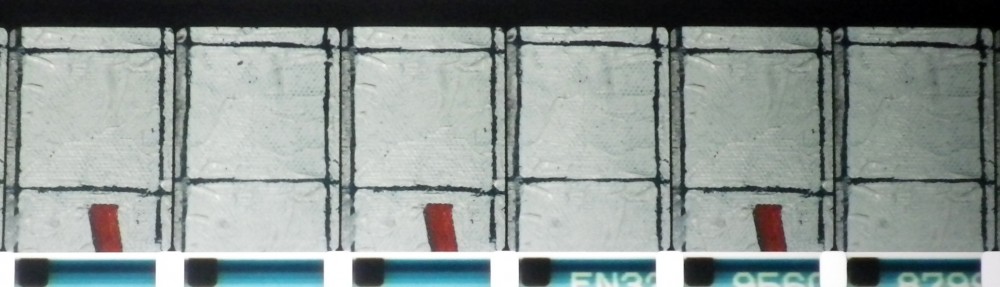
Grainy Realism: Four films by Vicky Smith.

Short essay on four films by Vicky Smith for a forthcoming DVD.

The four films on this disc exhibit continuities, in single screen format, with a preceding phase of work, undertaken for a PhD project, which began with rotoscoping figures by scratching into clear celluloid, to which body fluids and physical matter were added in subsequent films, to performances in which an inked bicycle tyre is ridden along a filmstrip, which is then projected.

The performativity of these precedents is abundantly present in much of the work here, from the precise handicraft of Small Things Moving in Unison (2019) to the exuberant physicality of Noisy Licking Dribbling and Spitting (2014). In the latter a regularly pulsing, livid red splat, filled with bubbles, envelopes the screen, gradually increasing in pace. We hear background radio noises and optical sound generated by the image, and as the pace increases to a climax there is a piercing frequency burst, generated by a printed section of optical soundtrack that then appears briefly in the picture area. At this point the pace slows for a while, yellow and orange fields displacing the saturated red of the first half of the film. Finally, the image breaks up into continuous snaking forms over a field of speckles and the sound grows in volume and intensity.

Noisy Licking measures out its pace in tongue-sized stretches, and, in its use of body parts to generate the image complements the earlier 33 frames per foot (2013), in which the artist inked her bare foot and imprinted it onto the film strip. Both films may be seen as rude counter-blasts to the altogether softer and more garishly colourful work of Jennifer West, who often works with cosmetics, such as lipstick kissed onto the film in Rainbow Party (2008). The use of contingent bodily measures; tongue, foot (Smith’s foot measure 33 frames of 16mm, against the 40 frames of the imperial, 12 inch measure) interspersed with blank pauses, calls to mind Stan Brakhage’s Mothlight (1965), in which rhythm is determined by the length of the various materials used until the end, where images are spaced momentarily along the film, like punctuation marks.
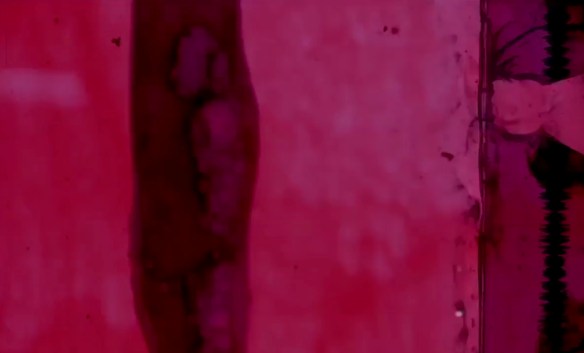
Noisy 2

In Small Things Moving in Unison, the simple, classical, but technically exacting method of scratching black film to create white marks is given a vibrant, virtuoso treatment. The film begins with a field of dancing dots that seem to grow and diminish in size individually, as well as coalescing into different compound shapes relative to the framing edges; rectangular blocks reform into narrow, horizontal spirals, thence into discrete balls, sometimes with hexagonal patterning. Two distinct kinetic processes are evident; the movement of the dots relative to each other, and the sections between frames of image that are left black in order to create an overall on-off rhythmic pattern. Frequently, the centre of the screen is empty, defined by a border of dots which regularly spread out until they hit the limits of the frame, at which moment a sharp, straight line appears, a gestalt formed by the eye-brain as it seizes on a regular, familiar shape. This happens frequently, establishing a play on shapes contained by the frame, and shapes that spread beyond it, but in the latter moments the framing edges become part of the image, holding it in, so that we don’t have a sense of off-screen in the usual way when something moves out of frame.
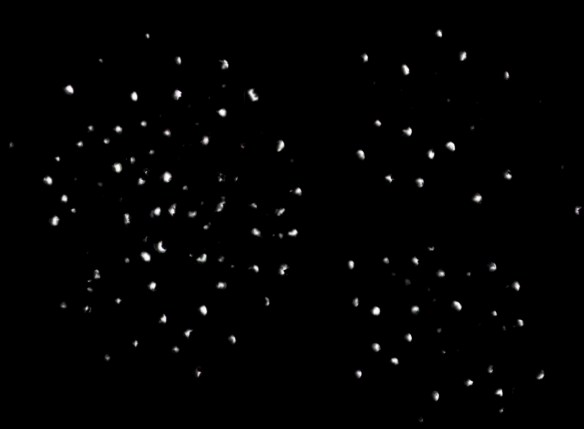
Small Things 2

Both Noisy Licking and Small Things are impressive in the way scale, kinesis, pace and rhythm are controlled and developed. Towards the end of Small Things the white dots become larger and resemble tears in the film, as if actually ripped out of the film strip instead of scratched into it. The implied sounds of Noisy Licking are deployed literally in Small Things, through Shirley Pegna’s soundtrack, which consists of busy, wordless vocalising; whispers, tongue-clicks and taps, sucking, moaning and mutterings, which grow to a crescendo as the white dots give way to the torn shapes, as if the shapes are caused by the sonic activity. Just as the soundtrack of Noisy Listening is briefly disturbed by the burst of synthetic tone, so in Small Things a knot of fine hair appears momentarily within / behind one of the larger holes, breaking the heterogeneity of means. One wonders how it got there. At the same time the holes are colour-fringed, suggesting the film was made from a strip of exposed colour film, and not black and white as the film has appeared hitherto.


Primal is in some respects a pared down companion to Small Things, beginning as it does with single, feint scratched shapes that flash up, interspersed with black pauses. The shapes grow larger and appear to have been bleached to produce gradations of desaturated colour. Dense nets of scribbled lines appear, as if cancelling the shapes, which themselves threaten to burst and escape the confines of the frame. Where Small Things is delicate and dancing, Primal is closer to Noisy Licking in mood. The film is considerably enhanced by Shirley Pegna’s complex, music track, a combination of concrète and instrumental sounds which, in its very scratchy, insistent quality, avoids falling into the trap of mood-creation. Both film and sound have room to breathe, so that one doesn’t feel one’s attention is divided, as it so often is.
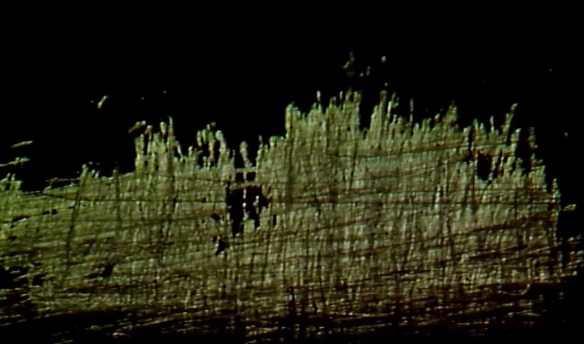
Primal

Not  (A)Part nods to Mothlight but also to Mothfight (1985), a much less well known film by Vanda Carter, a fellow filmmaker of Smith’s at the London Filmmakers’ Co-op. However, whereas Mothlight’s material lies flat on the film plane, the images constituting Not a Part are three-dimensional, photograms of ‘53 dead bees found on walks in southwest Britain’, as is stated in the text that appears near its beginning. This clear reference to the disastrous decline in the bee population, and indeed the insect population generally, is addressed in the shapes of dead bees, which are shown in negative, reanimated by their movement through the projector. The film serves as a kind of quasi-scientific study, a gathering of data, but put to different ends. In terms of themes and ideas this film differs from the others yet is of course connected in its being a camera-less animation.
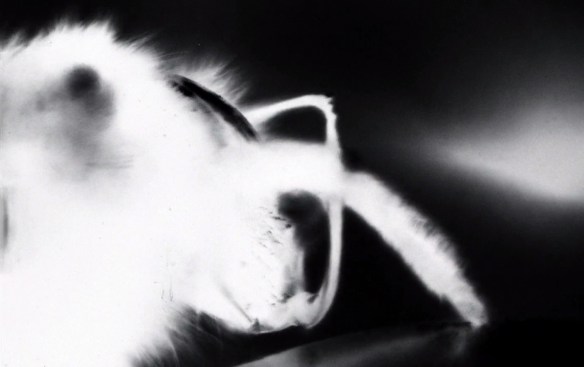
Not A Part

This long-established way of working has a rich history, which Smith has added to and enriched further with these four films, which range from the exquisite, finely wrought movements of Small Things Moving in Unison to the grimy, abject slapstick of Noisy Licking Dribbling and Spitting.
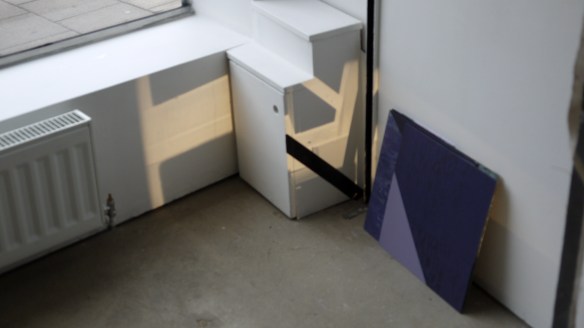
4 x 3 x 2: New multiple film loop work

New 16mm film loop work for two to four projectors. 4 x 3 x 2 was shot on Super 16mm, thereby generating an optical soundtrack when played on a standard 16mm projector. It was premiered at BEEF -Bristol Experimental and Expanded Film- as part of a one-day workshop with Vicky Smith, BEEF member, on Rayogramme and site specific film making on October 23rd, 2018. The version shown here is for two projectors.

Interval [ ] still : now is on at Tintype Gallery, London, during March 2018, with work by Moyra Derby, Jost Münster, Conor Kelly, Joan Key and myself. Thanks to Teresa Grimes of Tintype.

Images and video link below. All the work is designed to overlap in various ways, and further layers are developed by the mobility of the spectator. My 16mm film loop Standard 8, is a site specific work, in that the subject of the film is projected back onto itself in negative. The silhouette of the painting by Moyra Derby is in the film, while the actual work is adjacent to the projection. The second work Black White Black, is a two projector digital video, designed to be adaptable to different situations, here projected onto a free standing work by Moyra Derby and paintings by Jost Münster.

Nicky Tintype New Work

Wider view below shows a hanging work by Jost Münster.

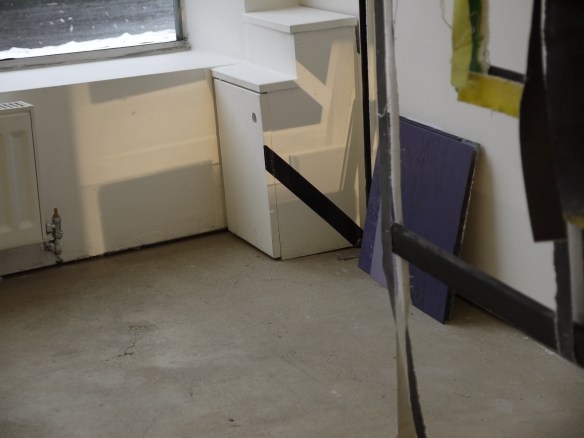
P1020507Interval [ ] still : now


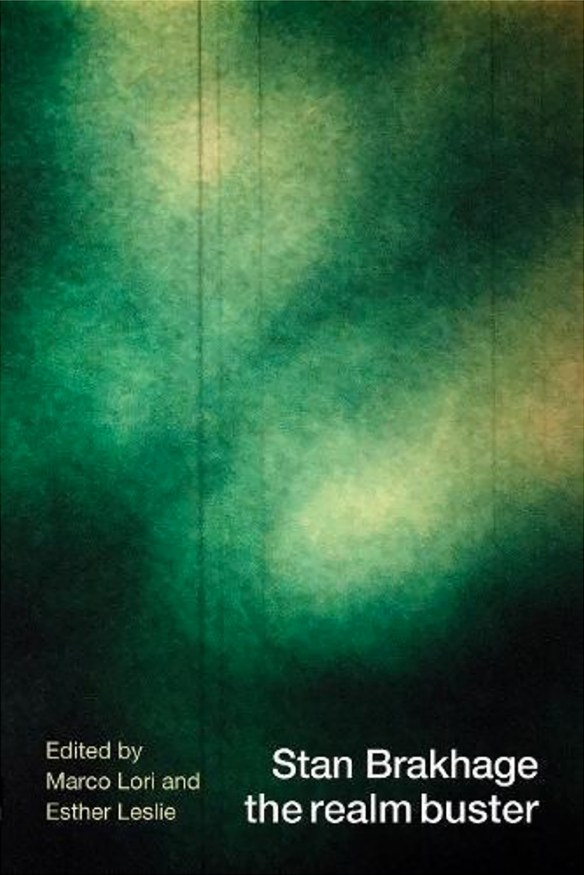
Stan Brakhage the realm buster

Brakhage cover

Edited by Marco Lori and Esther Leslie, published 09.01.2018 by John Libbey Press ISBN: 978-0861967285. Includes my essay on Brakhage’s use of black in several of his films, including some from the Roman Numeral Series, Arabic 14 and the extraordinary Passage Through: A Ritual (1990), which consists of fifty minutes of running time, for all but about a minute of which the screen is black. This is perhaps Brakhage’s most radical film and is certainly his most minimal. Book cover blurb below.

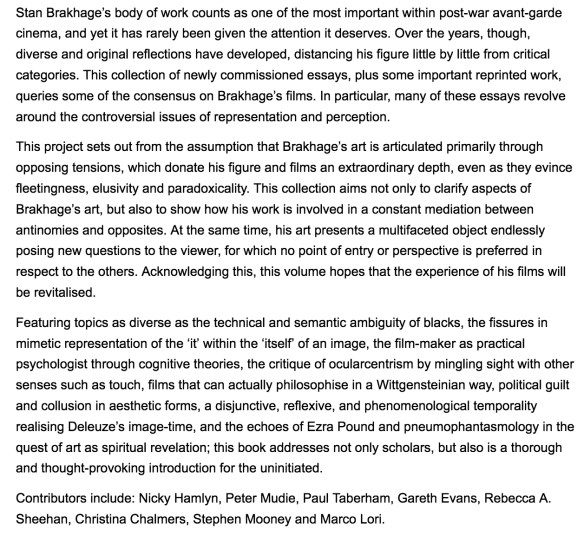
Brakhage Blurb

Pairs Screening text

This is the text written by myself and Neil Henderson for a joint screening the third of four such events, curated by Simon Payne, Andrew Vallance, Amy Dickson and Jamie Jenkinson.

Nicky: I came across a quote by Lucien Freud in which he said that the longer you look at something the stranger, but also the more real, it appears. This seems to me to apply to the experience of watching your films, specifically the ones shown here as well as others, and is something that I think our work has in common, among other things. Much of our work is observational, but the seemingly banal process of extended observation leads to mysterious, because unresolvable, features in the interplay between what is shown and how. The simple shot of a landscape becomes spatially complex and difficult to gauge, in the process of which one starts to question one’s perception. (Some of James Benning’s films also do this). This questioning of perception has been a paradigmatic aim of experimental filmmaking, but I particularly like the way your work challenges photographic naturalism -filmic veracity- on its own ground, rather than, for example, trying to do it by over exposing, blurring or de-focusing the image or degrading it in post-production, not that these strategies can’t be productive.
I also like the transparent economy of means in the work. One is struck, in contrast, by the gross wastefulness of big budget cinema. Twenty-four very expensively made photographs are discarded every second at the Cinema. These frames together form sequences of images that are barely noticed, glimpsed in the onward rush of narrative momentum. Even so-called slow cinema chucks a lot of material away before one has had time to consider it, because it is almost never concerned to facilitate unpressured or open-ended looking, the kind one would direct at a painting, but always at some level with the forward momentum of narrative and the distracted mental dispositions that generates. Your films are not like that: they give us something to look at which is what it is, and they give us enough time to do this, by for example, returning repeatedly to the same place in different conditions, which alters the apparent spatiality of a landscape.

—————————————————————————————————

Neil: The long takes, lens focused, static camera, I really like the clarity of that: ‘this is what I am saying’. I don’t think I ever really experimented with blur, over-exposing or focus, and I agree they can/have been important approaches across the history of experimental cinema. I think those devices are about distancing you from the image, which I’m not so interested in. I love that Brakhage made a load of out of focus films but have never been able to bring myself to do it.

The films I’m showing for this screening feature a lot of time-lapse. I think this is a really hard technique to master. You use it really well. In your film Object Studies, that sequence where we see the movement of shadows in foliage and trees (it’s in b&w), it’s amazing, and so simply made but what we see is incredible. The way the shadows are animated. I think it’s hard to use because it’s something we associate with natural history programmes.

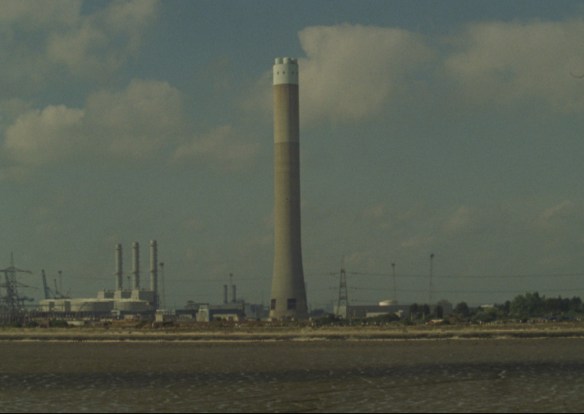
I shot a number of roles on the Isle of Grain for this film, there’s lots of de-industrialisation going on there and I’ve been using the old forts in the Medway as a place to leave the camera for a few days. The footage comes back from the lab though and you wonder why you bothered. The film tells you nothing you don’t know, time passes, the sun comes up and goes down etc. What are your thoughts on time-lapse and experimental filmmaking?
—————————————————————————————————
Nicky: I am a semi-closeted documentarist. It stems partly from my period working at the BBC where I was an assistant film editor on several documentaries. At the time I made a conscious effort not to be drawn into the cosy institutional culture –mid 80s, before Mrs Thatcher changed it forever- but unconsciously I must have absorbed a lot. Anyway, as many people have pointed out, all films are documentaries at some level. Time-lapse extends the possibilities of documentary to the recording of time in a way analogous to that of how lenses of different focal lengths extend or distort the space in front of them. One could think of time-lapse as being like a tele-photo lens that compresses time. It extends perception beyond the normal human range. In this sense time-lapse is a perfect example of Walter Benjamin’s ‘Optical Unconscious’. It’s scientific and surreal, like the early time-lapse films of plants growing. You see that in Object Studies when dead matter writhes in the growing heat of the day. (Actually I am not showing Object Studies on this occasion, but Gasometers 4 and Polytunnels, but it’s a similar work in many ways –same location and time of year, some time-lapse sections, etc) The first time-lapse film of any kind I saw was Raban and Welsby’s River Yar (1972), which was shown at Reading Museum and Art Gallery when William was an MA student at Reading University. I think I struggled to escape his influence for many years, so didn’t do much time-lapse for a long time, but then I realised that it’s not a particularly crowded field and any way most time-lapse films aren’t very good, most egregiously Godfrey Reggio’s Qatsi trilogy, which mostly spectacularises and glosses with some hippy philosophising. In the Gasometers series the structures are a pretext for making films about light, but I was also conscious of the fact that National Grid were about to demolish them, and now only the pair in Gasometers 4 are still there, or were last time I looked.
—————————————————————————————————

Neil: I think Raban and Welsby really own this area in experimental cinema, so I can see why you struggled to escape it (I think you do though), but yes as you say, there aren’t many. Emily Richardson seems like someone who has found something to say with that technique. I like that idea, the analogy with time-lapse to different lenses. One of the films I’m showing is a 10 min time-lapse of a man-made island in the Wash. The time lapse reveals its workings, the birds that live there, etc. It reveals something in this landscape very few people have ever seen.

This film of the Isle of Grain I’m showing will complement your Gasometer film very well. I’ve been thinking about the Freud quote you started this dialogue with, and I’ve decided to show a 10 min unedited view of this location on Grain. I was planning on cutting a lot of time-lapse footage against it but I think this will be better. This dialogue has helped clarify what I’ll show.

When I started shooting on Grain, just before the referendum, there were UKIP posters everywhere saying ‘Leave’ and ‘Out’. Just after the referendum a gang of lads went out to the fort and covered it in England flags. I was planning on leaving my camera out there for some time lapse work for a few days but thought better of it. The film of Grain I’m showing, in the context of all this, has become weirdly political, which is not something I had ever thought it would be.

Gasometers 4.


Isle of Grain.