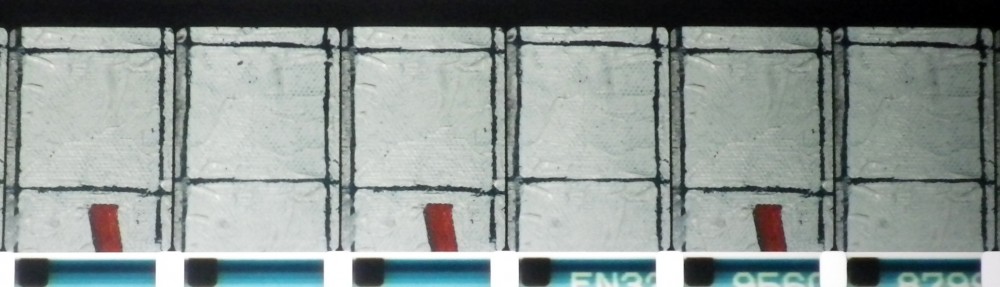
Medium Practices.
A considerably shorter version of the essay was published, with monochrome illustrations, in Public journal, issue 44 (Toronto: York University Press), in autumn 2011). (Couple of glitches found their way into the text in the process of uploading it, which I’ve been unable to resolve so far).
I am interested in works that could not have existed other than in the medium in which they were made. The essay develops out of two chapters in my book Film Art Phenomena (2003), which worked with an idea that different media offered different possibilities and facilitated particular ways of working and kinds of outcome: a kind of medium specificity-lite argument, in the sense that it held back from a stronger position on film, video and digital media as being absolutely distinct or antithetical (1). Actually, I don’t think it’s possible, or even necessary, to show that they are absolutely distinct in order to argue for medium specificity; they are, obviously, all media designed for recording moving images, and for many people, in a majority of production contexts, such as TV, the distinctions are simply irrelevant.
A second motive for writing was prompted by a feeling of resistance to the long running fashion for a rejection of medium-based forms in favour of so called post-medium practices. Practitioners, however multiple, mixed or post-media their work may be, can never escape the question of medium. In relation to photographic media, such attempts would seem to commit them to an ideology of transparency, while, more broadly, artists who mix media cannot ignore the specificities of those media’s histories and effects, just because they’re using them in conjunction with sculpture, drawing, installation or combinations thereof.
Thirdly, I wanted to challenge the assertion that medium-specific practices entail a commitment to a reductive kind of formalism (an assertion for whose proponents formalism is seen as intrinsically reductive anyway). Even assuming that such a formalism can apply to painting, which is always more complex and multifarious than the traducers of a Greenbergian position would like it to be, it surely cannot be applied to film and video, which combine optical, mechanical and electronic or photo-chemical stages in sequences that cannot easily be defined when taken together as a whole: this becomes clear as soon as one tries to answer the question what is a “film”? The fact of film’s compound technology also underlies -and makes possible- the range of works produced by artists that explore single aspects or stages of the medium, from Man Ray and Len Lye’s hand crafted filmstrips to Rose Lowder and Helga Fanderl’s in-camera films, to Malcolm LeGrice and Zbigniew Rybczynski’s printer collages to Guy Sherwin and Bruce McClure’s projection events. It’s hard to think of equivalent practices in photography, painting, sculpture or even video: in the latter case, there is a much closer bond between the recording device and its storage medium which, increasingly, has become part of the hardware of the camcorder or mobile phone, which also includes the means of sound and picture replay. Thus all the separate functions and stages of film technology are embodied in a single device: the video image is always already present, storable, viewable and reviewable, at the press of a button. (Compared to film, video, at least in its current state, is a black box technology, and to my knowledge no significant work has yet emerged from the re-programming or circuit bending of camcorders. The pioneering work of the Vasulkas, for example, was largely possible because early video production equipment consisted of large, separate analogue devices, that made access to circuit boards practical in a way that would be extremely difficult with the miniaturised circuitry of modern camcorders.) The idea that work will necessarily be reduced to being only, or even mainly, “about” its medium because it works with a notion of medium specificity, underestimates the medium’s -any medium’s- complexity. Even monochromatic paintings, however much they may be about flatness and edge, are always about other things as well; the relationship between process and meaning, the production of space and texture and the tension between them, perception and thought, the form of arrest and direction of attention etc. Film and video have the additional question of recording, if not representation, as their all but inescapable condition (2).
In what follows I will discuss a selection of works for which their medium is a central and critical aspect of what they are about, and where medium is an expanded term that includes the rendering of space and time and the viewer’s orientation in relation to them. Furthermore I hope to show that these works could not have been made in a different medium without their losing the meanings they generate.
In Neil Henderson’s Candle (16mm, black and white, silent, 2’ 50”, 2006), we watch, in reverse, a Polaroid photograph of a candle developing. The flame and the top of the candle itself are all that are visible against a black background. Thus the candle flame provides its own illumination as image: the flame is both light source and image. The film comprises an entire roll of 16mm film, so that the end-roll flare is also included, and forms part of the work’s meaning.
There are two kinds of movement in the image: firstly, the strongly visible pulsing of grain around the top of the candle and to a lesser extent around the edges of the flame, whose white centre is grainless. The second movement consists in the gradual lightening of the photograph as it un-develops. The shimmering grain brings the flame to pseudo-life, reanimating a classic symbol and measure of time passing, while its pulsation animates the flat duration that characterises static shots of static objects. It also marks the unseen passing of frames through the projector that are necessary to sustain this stasis. As the image gradually whitens, the visibility of grain constantly shifts: black and white grain is most visible in mid greys, so that as the background moves through that range, the grain becomes strikingly coarser, before rapidly disappearing as the image whites-out. The gradual lightening of the image also constitutes a kind of medium-specific movement, in the same way that the de-focussing of the photograph at the end of Michael Snow’s Wavelength more dramatically does (3). We tend to think of movement as occurring in the realm of the pro-filmic –subject and/or camera movement- and don’t realise that any change within an image is movement. This is the case with Candle: image change is image movement. Thus the film gives back to its subject the movement it was deprived of in the act of being photographed: given that the image moves, the “candle” does too, in a sense. But this is also a movement to its own demise, and so in another move the film reinstates to the lit candle its defining transience.
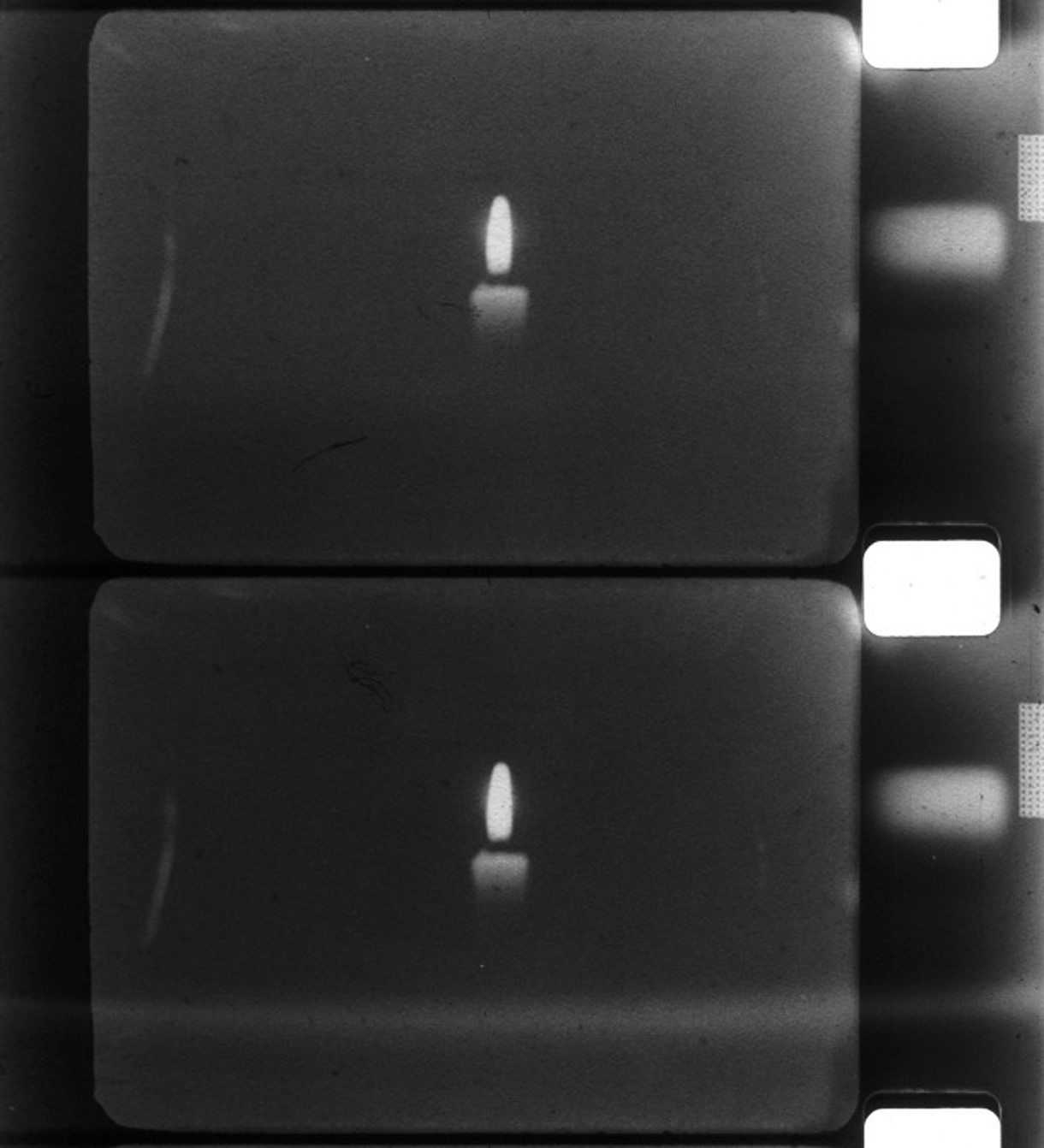
Candle, Neil Henderson, 2006.
When the screen goes to white, candle flame and background are united. As the film flares out at the end of the roll, we also pass from image-light to projector light; from image surface to screen surface, in an uninterrupted process that is self-defining in both form and duration. It hardly needs saying that if the same work were made on digital video, the relationship between fixed pixel array and image content would be static; no pulsation, therefore no marking of time, and no re-animation of the image or its attendant connotations. On a slightly broader level, the reconstitution of an image from electronically processed voltages deprives this work of its strongly indexical sense, whereas the flame burns, as it were, a hole directly into the photographic emulsion. (In the early days of video, the technology was closer in this respect to film, in that it was possible to burn images onto the vidicon tube inside the camera. The British video artist David Hall made a work that directly exploited this (4)). At the point of white-out, the film continues to run through the projector, so that we still see a mediated image, even though the candle has disappeared, whereas video’s equivalent is an imageless, unmediated light issuing directly from the projector’s lamp. The sense that we are still seeing an image, and not merely white, is also important to the meaning of Candle, because it reminds us that, as long as there is film running through the projector, we are looking at an image, even if the screen is “blank”. This premise accords with the work’s overall structure, given its move from near dark through to maximum lightness. Furthermore, it reaffirms the fact of film projection as a series of discrete components; film, projector, image, whereas the unmediated light from a video projector or TV screen issues from its technology, not from its image carrying medium, insofar as image-data and resulting image are one and the same at the moment of projection.
In Chris Kennedy’s Tape Film (16mm, colour, silent, 5 minutes, 2007) the filmmaker attaches strips of masking tape horizontally to a transparent screen that is hinged vertically, with a wider, left hand side section and a narrower one at an angle to it on the right. The hinge is visible as a brilliant strip of light, and bisects the frame in a ratio close to the Golden Section (1: 0.618). The framing is tight and the performance takes place in a dark space such that nothing is visible other than the dramatically lit screen and the filmmaker’s head, upper body and arms. Throughout, there are abrupt shifts between dark and light, and colour and black and white. Violent flares and apparent fogging disrupt the flow and frustrate the viewer’s gestalt-forming efforts, so that by the end of the film it is still fundamentally unclear as to the nature of the space and Kennedy’s position within it. The placement and direction of lighting is also highly ambiguous, so that Kennedy appears sometimes as reflected image and sometimes as a shadow or silhouette. The light on the right side of the screen could be the same kind as the band of light on the opposite side, or it could be edge fogging. But the way it occurs here raises the question of what the difference is, or why it should necessarily matter, since the light that enters through the lens and light that enters other ways are effectively the same, both image-forming, only differently mediated. Both make indexical impressions, trapped as traces that evidence a certain situation that existed in the room where the event took place. The light in the film, the fogging and the moments of solarisation caused by it, interact with the shadows and surfaces of the profilmic space; its transparent partitions, silhouettes and translucent tape areas, thereby generating ambiguities that are significantly derived from the film medium’s characteristics.
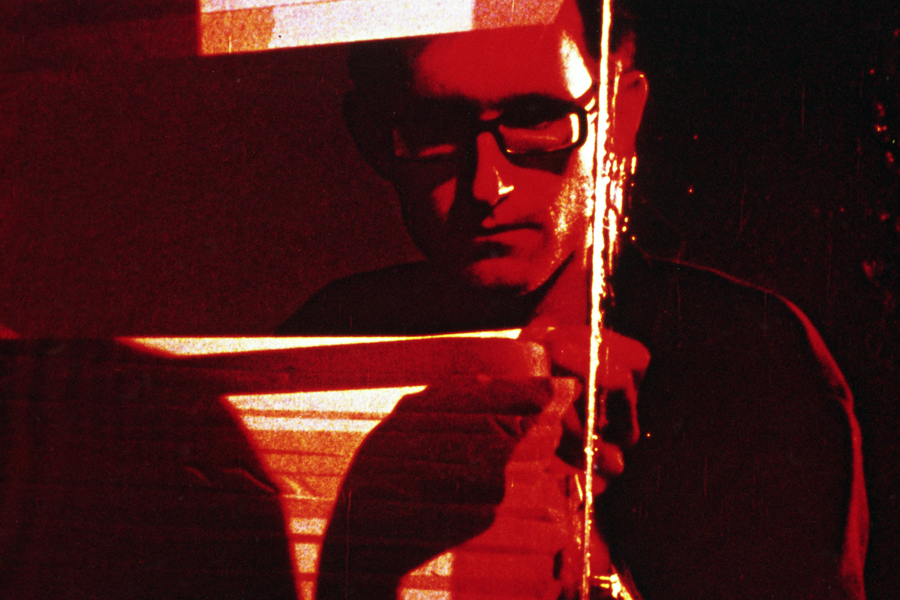
Tape Film, Chris Kennedy, 2007.
The film’s complexity turns on the creation of screens within screens, and here again, the fogging plays a key role. A film’s surface –the field of grain that bears the image- usually sits on the picture plane, and depending on the coarseness of the grain, one can flip one’s attention between this surface and the represented space of the pro-filmic, in films of this kind. In Tape Film, however, a number of strategies complicate matters. The application of tape establishes the evolving screen within the screen of the performance, realised and developed in the duration of the work, while the fogging periodically sweeps away the grain texture, simultaneously imposing a new surface level. There are thus at least three interacting layers; screen surface, created screen and fog-light screen. The created tape-screen develops gradually more resistance to the effects of fogging as it grows in area, and the pro-filmic seems thereby to stabilise, but the fogging weakens the image contrast, undoing the effects of the taping. At certain points there are little more than marks on a dark surface, which both reassert the framing edge and posit another surface that is neither on the picture plane nor illusionistically in it. At these moments we are looking solely at the film surface though it is not visibly a surface, but rather functions as a barrier or mask, through whose scratches light escapes to appear not as on a surface but as lights flashing briefly in the dark.
Towards the end there is a long passage of intense light-flare and flicker, apparently from fogging, but it’s not actually clear if this is the case, since some of the light seems to come from a source, which, of course, it does in one sense. We are forced to question what counts as an image, what is intentional and what not. It goes without saying that such imagery could not have been generated with a camcorder. Nor, however, is this a reductive assertion, since the interplay of different lights has a direct and complex effect on the spatiality and illusionistic aspects of the image. At the beginning of the film the tape appears translucent, if not opaque, since there is an initial correspondence between the strips of tape and the stripes of Kennedy’s tee-shirt that imply a projection through the tape to form an image on his chest, but this impression is soon dispelled. It appears that the tape has variable degrees of translucency, depending on the angle at which light hits it. By the end it has become opaque; silvery and wholly reflective, simultaneously obscuring the space behind it, while the figure, previously apparent as front lit, now appears in silhouette. This latter, whose flat opacity depends reciprocally on the tape’s own density, forms a new screen or layer within the work, stabilising the place of the tape-screen, yet newly redefining the space, since it contrasts with other points in the film where Kennedy’s image is front-lit and hence three dimensional, and the screen’s location and orientation different while similarly unclear.
The mix of film stocks productively hinders the comprehension of the image: in other words it’s not merely a decorative or graphic effect as it often has been in films that use a mixture of stocks. Since the interferences are not pre-planned or contrived in post-production, the film can be said to generate something not previously known. By contrast, the application of colours or modifications to contrast etc in post production would have to be done on the basis of what can already be seen to exist, and therefore in response to that, so that its effects are predictable and adjustable towards an end goal. Either way the results are artificial. The use of different film stocks combined with hand processing, however, leads to uncontrolled interactions that generate unanticipated effects; new experience that counters the given of the iconic photographic image. Thus the strategy depends on the nature of the medium used, and here specifically it depends in part on the fact that ultimately one is working blind when working with film, especially where fogging is concerned. The kind of experience generated, and the way it is generated, is unique to film, notwithstanding that one can have some sense of what is going to happen when one deploys certain materials in a certain way. Video editing and painting, by contrast, share the same feedback-based working procedure whereby a mark is made, or an image generated, which is then responded to and modified. In painting this is done directly in the making process, in video it is done either through live mixing or in post-production.
In video the use of post-production methods to interfere with the perceptual-spatial stability of the image involves a synthetic activity, as in a work like David Larcher’s Ich Tank, where new kinds of spaces and objects are sculpted from conventional footage through processes of fragmentation, distortion, multiplication and recombination (5). This is a very different process from the blanket treatment of a given image, such as the use of filters in Wavelength, where coloured gels over the lens are applied to the whole image achieve a flattening effect by altering the contrast between objects. While such effects could be done digitally in post-production, the relationship between performance-process and medium-knowledge is fundamentally different. The video image exists as a provisional structure, wholly mutable from the bottom up, whereas the film image is what it is all the way through, from the very beginning: it can be subsequently supplemented, but not modified in itself: even with scratching or over painting, the filmed, iconic image remains, as in Stan Brakhage’s Eye Myth (colour, silent, 9 seconds, 1972), where the original images clearly persist as such, even if only glimpsed beneath dense layers of scratching and over-painting. So a film cannot but attest to its method of production: it exists as a record of its making in a way that video can only simulate, insofar as the latter is reconstituted from transduced, converted and filtered data. Post-production treatment involves the fundamental restructuring of the image data, and is a predictable and reversible process. Painting is similar: an additive process of building up undertaken in a trial and error fashion. This process includes most, if not all, subtractive actions, since the removal of paint from a surface is rarely absolute, or if it is, the removal from a surface usually can modify it in a way that may still have consequences for subsequent applications of paint. The new knowledge that emerges from the unpredictable interplay between film medium and image emerges from a retrospective analysis, as opposed to that which emerges from video post-production, that is, through a generative, feedback process.
Cathy Rogers’ Super 8 films 14.11 and Scotopic (both 2009-10) explore metrical relationships between the spatio-temporal scale and physical form of the filmstrip and its subject. In the first, a set of pinhole cameras was made to house 2ft lengths of Super 8 film. These were placed on the northeast-facing windowsills of an industrial unit in a large building in Maidstone, Kent, which face a busy railway line that runs roughly parallel to them. The films were exposed at the moment a train arrived from London into the platform at Maidstone East station. They were then processed, joined and projected at 6fps.
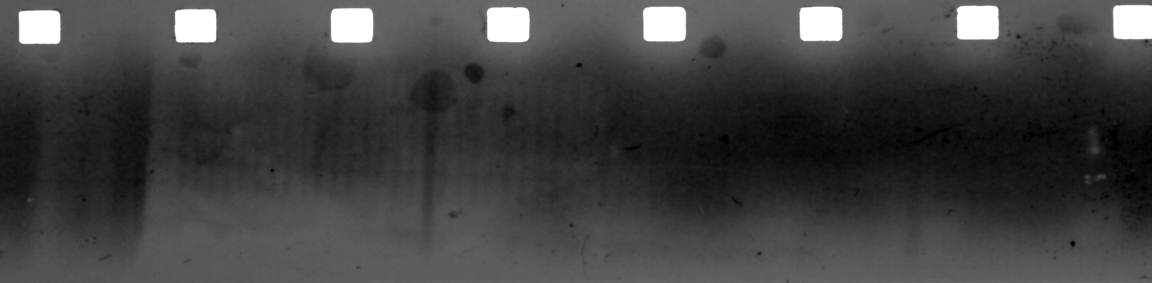
Part of a frame strip from 14/11, Cathy Rogers, 2009-10.
Rogers says of the film: “14.11 derives from the desire to capture simultaneous moments of time at once. As the train arrives onto the platform it moves through the window frames (of the unit), which visually segments its progress like a film-strip running through the camera”. This is true both figuratively and literally, and, one could add, the train’s own windows bring a third interacting layer to that between windows and film strips, figuring, as Rogers implies, the processes by which the work was made. Within each camera a number of frames (approximately 160, or 6 ½ seconds running time) are simultaneously exposed. Thus the film records a spatially contiguous sequence of views of the passing train at a single moment in time, in a technical move akin to the pinhole Time Slice camera originated by Tim Macmillan and later popularised in the camera-based system of The Matrix. Here, though, there is an isomorphic relationship between medium and subject in the longitudinal, segmented form of both filmstrip and train, and a mutually reflective one in the manner of recording. The piece turns on its being, as a filmstrip, a series of static moments that are spatially contiguous and temporally simultaneous at the moment of their sampling, but discrete and momentary in their re-presentation as projected film. The work thus instantiates a disjunction between the near identical means of recording and projecting, in which both camera and projector utilise a shutter to break time and space into fragments.
In The Matrix, as well as a number of TV ads, the spectacular flight around an object frozen in space and time frequently takes the form of a 180 degree rotational tracking motion that occurs in a plane at right angles to that of the object being circled. (In theses examples, the seemingly radical step of Time Slice appears conservative since, in its limited rotation, it conforms to, and thereby reasserts, the 180 degree principle, as opposed to Tim Macmillan’s system which is 360 degree). In Rogers’ film, by contrast, the imagery is aligned on the filmstrip in a configuration that mirrors its subject: it is a complete, longitudinal photograph of the train at a given moment in time. The projector animates this still image, but in order to do so must fragment the continuity of the filmstrip both spatially and temporally, in order to turn a momentary image into a time-based one.

14/11: Production photo showing one of the cameras in situ, photographing a passing train.
No moving image technology that depends on the fragmenting of time into a sequence of discrete moments can adequately represent its subject; 14.11 must remain either as a photograph, thereby abandoning its ambition to record movement as such, or it may become a movie at the cost of negating its status as a true, or truer record. These negations are equally true of all such attempts at complete or continuous time based photographic representations, from Marey’s Chrono-Photographs, in which the image promises to reach saturation point when all its moments are co-present, to Paul Sharits’ films for shutterless projector, where image iconicity is sacrificed to true spatio-temporal continuity (6). Rogers’ film sits among these various manifestations of critical-technical filmmaking, broadening the area for moving image practices that question their own adequacy.
14.11 embodies a use of film entirely distinct from video, demonstrating some fundamental differences between the two. Here film is brought into the world to encounter its subject in a direct manner. The physical disposition of the film material and its technology is adapted to the situation in which it will make a record of a mutually defining encounter. The medium is flexible (sic) and adaptable: its character as both indexical and physically malleable, and its technology, the camera, because separable, can be adapted independently of the film itself. This allows it to be used non-instrumentally, as a recording device in which unconventional applications are possible, and wherein the relationship with the pro-filmic can be infinitely re-configured. There is an illuminating precedent here. Before he started making films, William Raban made a number of works in which canvas was tied to a tree and allowed to weather for prolonged periods of time: “Whilst a student at St Martin’s School of Art (1967-71) some of my paintings involved lifting traces from a range of natural phenomena…The Tree Print series (1969-73) worked like photographic time exposures. Tree trunks were wrapped in canvas soaked in organic dyes. After six months of weathering and exposure to sunlight, I removed the canvas to reveal a permanent coloured texture of the tree imprinted on its surface. Both the wave and tree prints were concerned with using elemental forces as a means for making images. My thinking was inspired by the dictum from Thomas Aquinas that “art imitates nature not through mere appearance but in her manner of operation”… this idea seemed to suggest that naturalism in art need not be confined to mimetic representations of nature, so much as by attention to modus operandi and the intrinsic properties or materiality of the artistic medium”. (7).
Scotopic is: “a more intimate study of a small hole in the floor of the same room, through which the space of the room below is visible. A single frame is taken with the hole positioned centre frame, covering every increment of the focal length through the range of a 15-60mm zoom lens. After each cycle the Super 8 hand held camera performs a slow pan of the area so that the hole no longer is centre frame” (Cathy Rogers). Here a complementary operation is undertaken, in that the images are sequenced in another spatial plane, along the axis between lens and infinity. The hole becomes a kind of pinhole, and thus the film a kind of pinhole film, in which two spaces, the room below and the camera’s dark interior, are in a complementary relationship. As in 14.11, Rogers’ approach is to expand, or break, the use of film in its conventional relationship with the camera as co-imaging device. Even though she is using a camera here, the hole in the floor becomes a kind of lens extension, connecting the camera with the pro-filmic in a quasi-physical way, and hence changing the camera’s usually distanced relationship to its subject. This “lens” is also the light source and subject of the work, which applies a precise technical procedure to the contrastingly ineffable subject. As with 14.11, the association with pinholes grounds the work in film’s photographic pre-history, in a period when its technologies and techniques were still in flux.
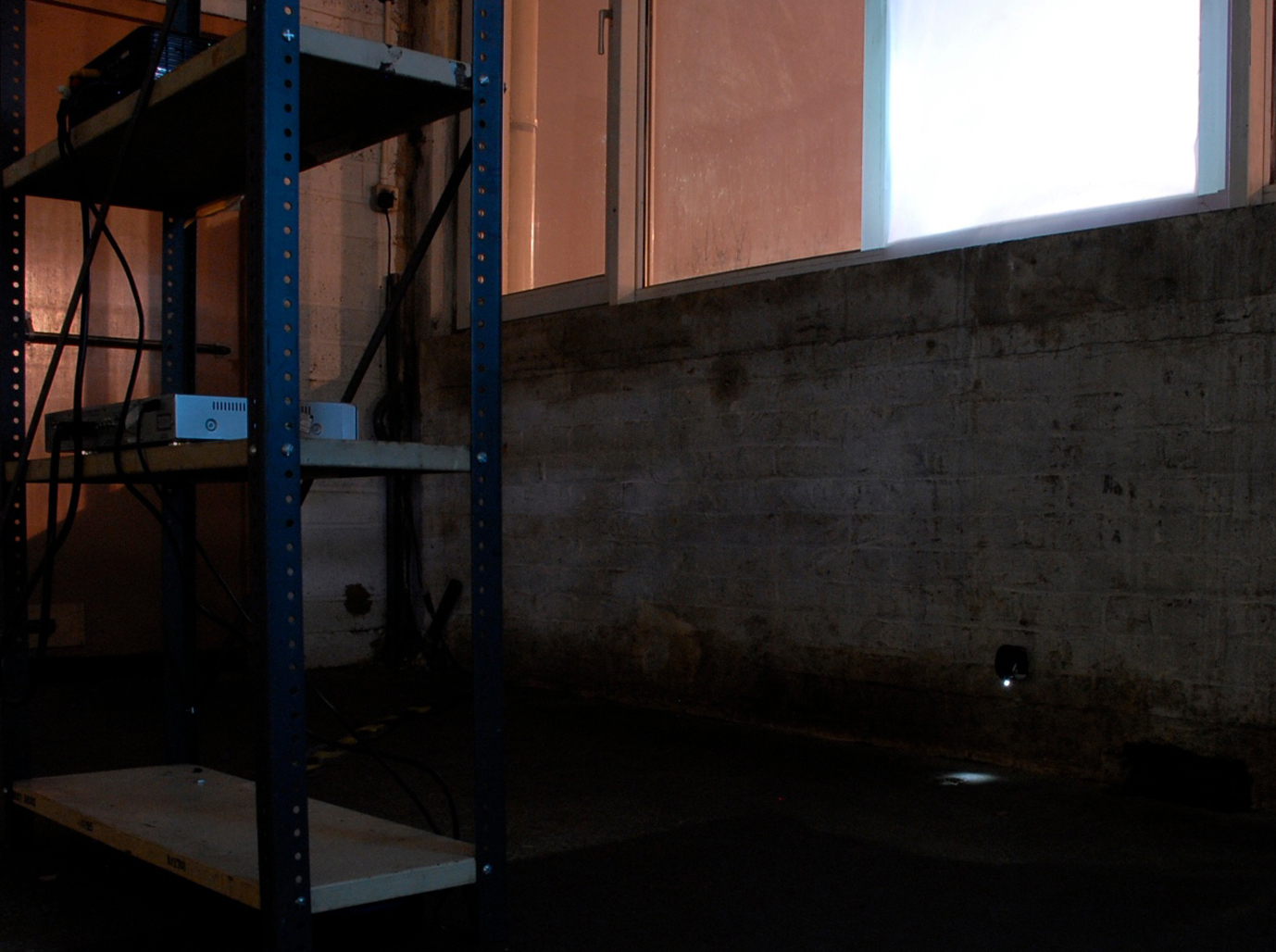
Scotopic: installation view showing projection above and the illuminated hole in the floor below.
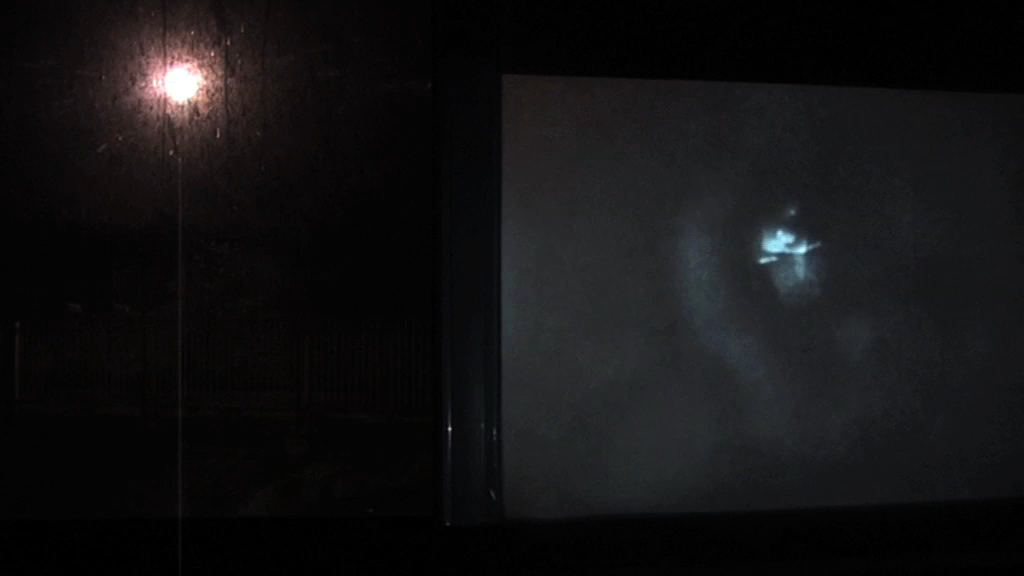
Scotopic: installation view showing back-projected image on right and the reflection of a street lamp on left.
Rogers’ films can be seen as an attempt to move beyond the narrowly mimetic image-producing function of camera technology. By liberating film from its accompanying apparatus and using it in a freely configured way, Rogers questions the prioritisation of the two dimensional image conjured from out there, and which is thereby necessarily divorced from it, in camera based recording processes. This prioritisation is especially exemplified in the phenomenon of the camcorder, which exists as a highly circumscribed and convention-bound image generating package, and which, in its strictly regulated technical parameters, default aesthetics and modus operandi, must distance itself from its subject through pre-determined, and hence indifferent, image generation, in order to function as such. The images it will make will be uniform, regardless of the situation in which they were made. In the broadest sense these kinds of images are generic; instantly recognisable as such and unbending in the manner in which they chew up their subject matter and re-render it.
Needless to say, all of the above does not preclude the possibility of making interesting work with video. Callum Cooper’s Victoria, George and Thatcher (colour, sound, 2 minutes, work in progress) deftly exploits the constraints and uniformities of the camcorder, and specifically the possibilities offered by the screen that has supplemented or replaced the viewfinder in camcorders, digital still cameras and mobile phones. One of the significant consequences of having a screen instead of a viewfinder is that the image is always already formed and visible as such. When one presses the shutter release, all one is doing is storing a moment in that continuity, briefly arresting, or rather sampling, the stream of data that flows constantly through the camera’s circuits. Cooper’s film, compiled from precisely aligned photographs of London row-houses, and shot on an iPhone 3gs, takes advantage of the ever-present screen image to allow him to create a template to structure a work based on precise repetitions and differences. The camera faces its subject square on and keeps a clear distance from it. The work’s particular strength comes partly from the fact that video imagery is so consistent, allowing the numerous small variations in the pro-filmic to have maximum impact, unimpeded by fluctuations in exposure or colour balance. The piece was made by marking key points on the phone’s screen with a chinagraph pencil, and using these to align successive shots. Cooper then elaborates a virtuoso animation, varying the pace and building zooms into the sequences. It is thus a film that breaks the boundaries between animation and “live action” since it is both animated and of the world, graphic and cinematic, a photographic series cum movie.



Adjacent frames from Victoria, George and Thatcher, Callum Cooper, 2010.
Finally, Simon Payne’s New Ratio (colour, sound, 1’ 40”, 2007) is a pure digital work, created entirely in a computer. Payne describes the piece as follows: “New Ratio is the first piece that I’ve made that explicitly explores the move from the 4:3 screen ratio to 16:9, which is now effectively the standard for broadcast television and video in general. The colour fields that comprise the work involve a tense relationship with the edge of the screen. In commenting on this piece Sean Cubitt has suggested that the equal mixture of additive and subtractive colours is effectively a ‘democratisation of colour’. Each colour has been assigned a particular tone: white was attributed a standard 1KHz test tone; the pitch of the tone attributed to blue was half that of the test tone; and each of the colours in between (in descending order of luminance) were attributed tones at intervals between these values. An additional sound is the ‘pip’ every time there is a cut. This sound was the result of a glitch, but it has become an integral part of the soundtrack. The video comprises two simple repeating sequences, which are fundamentally the same duration. However, one sequence includes an additional frame of black that throws them out of synch causing a phasing that effects different mixtures of colour, a range of tone combinations, and various pulsations in the soundtrack and within the frame. There is a discrepancy between the formal structure of this piece (as described) and the perceptual effects that arise, which are far more difficult to account for.” (8).

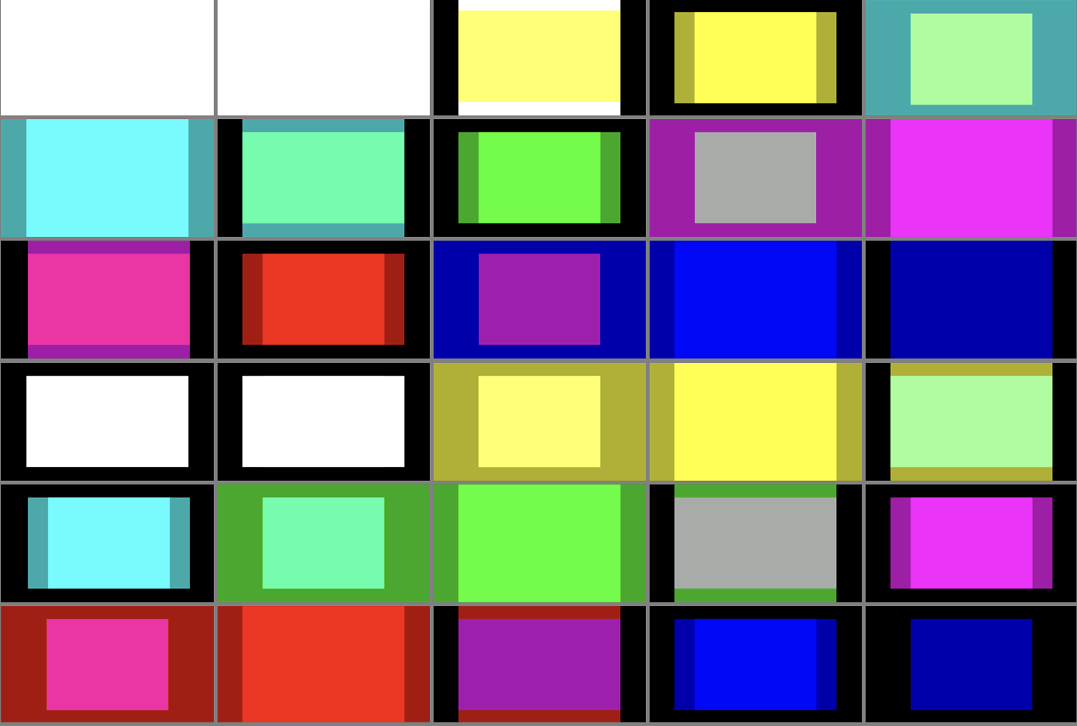
Two sequences of colour fields from the second cycle of New Ratio. Simon Payne, 2008.
The work’s effectiveness, again, is due in part to the consistently clean and flat colour fields, and the absence of grain and film flicker, which allows the resultingly pure colour frame sequences to generate impure interactions with each other, unimpeded, uncomplicated, by surface textures or imperfections, like an electronic version of a Steve Reich phase pattern piece. The video flicker engendered by the work’s construction is quite different from the regular rhythm of film flicker, and is key to the kinds of effects that are generated, which are more complex and unstable than film’s 24fps pulse. Another important aspect of the work is its hands-off aesthetic: our attention is directed wholly to its unfolding as an abstract sequence, unmediated by notions of craft or subjectivity. Thus the work shares something with other systems art, for example the painted reliefs of the British artist Malcolm Hughes, but without a trace of the hand made that marks that work, be it in the presence of brush strokes or slight imperfections in construction, or in the use of curves or more anthropomorphic or suggestive shapes. New Ratio, by contrast, has a iron logic in that its forms are derived directly from the given parameters of the technology from which it is constructed. In a much broader sense, the work itself is not an object but a portable, digital file –a virtual film- that can be stored in a number of media, and is thus independent of those media though it is, obviously, senstive to its forms of presentation, be it TV monitor, projector or web.
I started this essay on a note of caution, aware of the pitfalls of trying to define absolute differences between film and video. Now it seems increasingly clear that in a number of specific respects they are fundamentally different. These differences, however, become apparent not in the process of trying to describe them in the abstract, but from looking at how artists, in using them, have opened up and defined important differences. In other words, if one simply describes what these media do, then there is merely the obvious and superficial point that they share their most important function and raison d’etre: the generation of moving images. However, when one breaks them down into their constituent parts, and looks at those parts in relation to specific practices, one witnesses the emergence of unbridgeable gulfs in the way the media relate to, and can address, the world of their representations.
I am grateful to A L Rees for commenting on an earlier draft of this essay.
1. Film Art Phenomena, British Film Institute, 2003, chapters one and two.
2. ‘Film, “Motion Picture”, and “still” film, unlike painting and sculpture, can achieve an autonomous presence without negating iconic reference because the phenomenology of the system includes “recording” as a physical fact’. Paul Sharits: Words per Page, Film Culture 65-66, 1978, page 31.
3. Wavelength, Michael Snow, 16mm, colour, sound, 45 minutes, 1967). Wilhelm and Birgit Hein systematically and somewhat didactically explore this and a set of related issues in their film Structural Studies (16mm, colour and black & white, 40 minutes, 1974)
4. David Hall: Vidicon Inscriptions, analogue video, black and white, 30 minutes, UK, 1973-4.
5. David Larcher: Ich Tank, video, colour, sound, 59 minutes, UK, 1998.
6. For example: Sound Strip/Film Strip (1972).
7. (William Raban: Early Works on Canvas and Paper, in The Expanded Cinema Book, ed. Duncan White, David Curtis, Steven Ball and A.L. Rees, Tate publishing, 2011.
8. Simon Payne at: http://www.simonrpayne.co.uk/
 Nicky Hamlyn